
Precision Engineering: Optimizing Classic Eyeglasses for Modern Prescription Lenses
In the optical industry, a frame is only as good as its ability to hold prescription lenses accurately. While fashion drives initial consumer interest, long-term wearer satisfaction depends on optical alignment, pantoscopic tilt, and structural stability. Classic eyeglasses remain the top recommendation among optometrists because their proven geometric shapes easily accommodate a wide range of corrective lenses—from high-index single vision to complex progressive lenses.
At Xiamen Agada Optical Co., Ltd. (agadaeyeglasses.com), we engineer optical frames that blend classic aesthetics with precise technical standards, ensuring optical labs and retailers can glaze lenses efficiently without frame distortion.
1. Why Classic Eyeglass Frames Excel in Lens Accommodation
Complex optical prescriptions—such as progressive lenses or high-astigmatism corrections—require adequate vertical B-measurement (lens height) to fit reading, intermediate, and distance zones seamlessly. Traditional geometric classic eyeglass frames naturally provide optimal vertical height, allowing lab technicians to align optical centers precisely with the wearer's pupils.
Furthermore, deep V-groove channels cut into acetate and metal rims prevent thick high-index lenses from flaking or popping out under daily thermal changes.
2. Frame Balance and Weight Distribution in Classic Glasses Frames
As digital screen time increases, consumers increasingly pair classic glasses frames with specialized blue-light blocking and anti-reflective coatings. However, heavy or poorly balanced frames can shift forward, disrupting the intended focal point of the coated lenses.
To prevent slipping, modern manufacturing incorporates:
Ergonomic Bridge Geometry: Distributing front weight evenly across the nasal bone.
Balanced Temple Counterweights: Tapering temple arms to counterbalance front lens weight, ensuring stable optical alignment throughout the workday.
3. Fitting Technical Prescriptions in Classic Mens Glasses
Male wearers with strong prescriptions often face challenges with heavy, oversized frames. Sourcing well-engineered classic mens glasses resolves this by pairing generous eye sizes (such as 53mm to 56mm) with thin, high-density acetate or titanium rims that conceal lens edge thickness.
Providing adjustable nose pad arms on metal styles further enables opticians to fine-tune vertex distance and pantoscopic angle, delivering custom optical precision for broad or asymmetrical facial profiles.
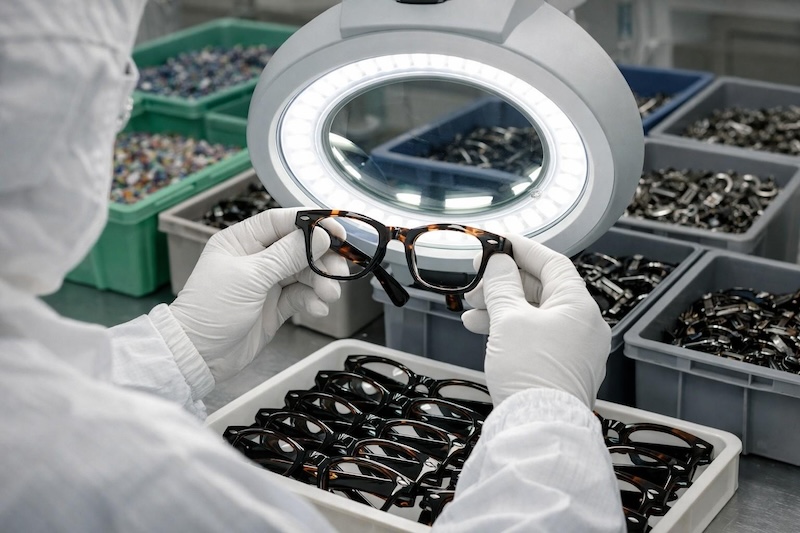
4. Manufacturing Quality Control for Classic Eyeglasses Frames Men's
For optical brands, minimizing lab rejection rates and lens edging errors is crucial for profitability. When sourcing classic eyeglasses frames men's series, buyers should partner with manufacturers that maintain strict tolerance controls across production batches:
Rim Dimensional Stability: Checking lens grooves under optical comparators to ensure zero warping.
Hinge Alignment: Ensuring temple angles remain rigid so the optical axis stays aligned during wear.
By prioritizing optical functionality alongside aesthetic appeal, brands can offer frame collections that opticians trust and recommend. Explore custom OEM/ODM optical solutions at agadaeyeglasses.com.